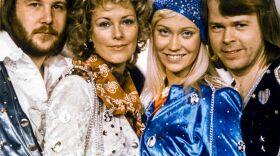
In 2004, singer-songwriter Regina Spektor was a staple of the so-called anti-folk scene when she sat down for one of her first public-radio interviews with the now-defunct WNYC program The Next Big Thing. In the interview, she joked that she stayed up until 3:30 a.m. writing a song, trying not to wake the neighbors, but never wrote anything down.
Muslims (in the foreground) face a group of Christians during a bloody clash in Ambon, the provincial capital of Indonesia's Maluku Island, on Sept. 11, 2011. The riot exposed deep fault lines between Christians and Muslims in Indonesia.
Credit Ulet Ifansasti / Getty Images
Indonesian Catholics pray during a re-enactment of the crucifixion of Jesus Christ on April 6, Good Friday, in Klaten, Indonesia.
In the city of Bekasi, Indonesia, outside Jakarta, a handful of Christians head to Sunday worship. But before they can reach their destination, they are stopped and surrounded by a large crowd of local Muslims who jeer at them and demand that they leave.
This is the Filadelfia congregation, a Lutheran group. They are ethnic Bataks from the neighboring island of Sumatra who have migrated to Bekasi, and they have been blocked from holding services on several occasions. Recently, a journalist who demonstrated in support of the congregation was beaten by an angry mob.
Shares of Facebook on Wednesday made up a little of the ground they've lost since the company's troubled stock offering last week. But the company and its lead underwriter, Morgan Stanley, still face a lot of legal problems.
Some of the investors who bought shares of the company filed a lawsuit alleging that the two companies concealed information about Facebook's expected performance.
Patient Bob Berquist with Gregory Wagner, a doctor in the emergency department. Berquist, who volunteers at Fauquier Hospital, was admitted for low blood sugar when another nurse noticed he seemed dizzy.
warrenvill_hospital001.jpg
warrenvill_hospital002.jpg
Credit John Rose / NPR
The chefs in the cafeteria try to buy whatever food they can't grow in the garden from farms as close to home as possible.
Credit John Rose / NPR
Lisa Spitzer, a registered nurse, is a Planetree program manager and concierge at Fauquier Hospital. She visits patients and offers a friendly ear and a helping hand.
Credit John Rose / NPR
Patient Bob Berquist with Gregory Wagner, a doctor in the emergency department. Berquist, who volunteers at Fauquier Hospital, was admitted for low blood sugar when another nurse noticed he seemed dizzy.
Credit John Rose / NPR
Twice a week, local seniors in Warrenton, Va., flock to the hospital's cafeteria, called The Bistro, for a meal, a great view and musical accompaniment by a retired piano player from a nearby Nordstrom's.
Credit John Rose / NPR
Each birthing suite is designed for the newborn to remain in the room with the mother, and there is an additional bed in the room for dad, or other care partner.
Credit John Rose / NPR
Family and friends are welcome at the hospital anytime, day or night, and each of the 97 patient rooms is designed as a single-occupancy room with a bed for caregivers to spend the night.
Credit John Rose / NPR
Fauquier Hospital was among the first five hospitals in the nation — and the only one in Virginia — to meet a specific list of criteria that qualifies it as providing truly patient-centered care.
Credit John Rose / NPR
The organic garden outside the hospital supplies the kitchen with fresh vegetables and herbs. Even the wood used for the trellises is untreated so that chemicals don't leach into the garden soil.
But some hospitals around the nation are trying to make their patients' stays a little less unpleasant.
They're members of an organization called Planetree, which was founded by a patient named Angelica Thieriot, who had a not-so-good hospital experience back in the 1970s.
It's time now for your letters. Yesterday, we remembered Eugene Polley, the inventor of the first wireless remote control. He died last weekend at the age of 96. Polley earned 18 U.S. patents in his long career at what was then the Zenith Radio Corporation in Chicago.
JOHN TAYLOR: But he will always be best known as the father of the couch potato.
SIEGEL: That's John Taylor, a spokesman for what is now Zenith Electronics and its parent company, LG Electronics.
A storm is brewing in Washington that could darken political debate for months to come. It's about the debt, the deficit, taxes and spending — all hot topics lawmakers have been fighting about for years now.
This time, though, there's a deadline, and the consequences of inaction would be immediate. That has many in Washington saying: Here we go again.
In the past week, President Obama and House Speaker John Boehner have begun a new round of sparring over the U.S. debt ceiling.
Greece holds parliamentary elections next month because the elections earlier this month failed to produce a governing coalition. The two big parties that had signed on to Europe's austerity terms no longer account for a majority of the seats in parliament. The big new player, coming in second was the Coalition of the Radical Left, or Syriza, which opposes Europe's terms for a bailout, but says Greece should continue to use the euro.
Michael Phelps has won more medals, and more gold medals than any U.S. Olympian. But how many people have heard of Ray Ewry, perhaps the all time greatest Olympic athlete on land? Ewry entered 10 events and won 10 gold medals. That his events no longer exist, and that he won his last gold 104 years ago are what contributes to Ewry's relative anonymity.
Sufjan Stevens is a classically trained singer-songwriter whose recent work has leaned symphonic. Son Lux is a classically trained beatmaker whose solo albums do indeed evoke luxury. Serengeti is a self-trained rapper who creates voices for a panoply of full-fledged characters who range from scufflers to yuppies. Billed as s / s / s, this ad hoc trio has just released an EP called Beak and Claw that somehow synthesizes their specialties.
Rewinder operator John Danylieko moves a finished roll of currency paper from the paper machine. The roll will be cut into three narrower rolls before being cut into sheets.
Credit Robert Benincasa / NPR
Crane & Co. Vice President Doug Crane stands near a spool of paper used for $20 bills, as it spins at the company's Wahconah Mill.
Credit Robert Benincasa / NPR
A "size press" coats the currency paper so that it's compatible with the Bureau of Engraving and Printing's intaglio printing process.
Credit Robert Benincasa / NPR
The rotary digester, about 15 feet across, uses steam and chemicals to cook away the contaminants in cotton and linen fibers.
Credit Robert Benincasa / NPR
Several tons of linen fibers drain and cool down after having been cooked in the rotary digester, a giant steel ball.
Credit Robert Benincasa / NPR
Marites Wilbur performs a final inspection on a ream of 32-note currency paper sheets.
Credit Robert Benincasa / NPR
A currency template is used to check that security features, such as a watermark of Andrew Jackson's image, are in the right place.
DALTON, Mass. – If you were driving through this small town along the Housatonic River in the Berkshires, here's something you might not think about: All the bills in your wallet are visiting their birthplace.
The paper for U.S. currency, the substrate of everyday commerce, has been made here since 1879 by the Crane family.
Crane & Co. vice president Doug Crane represents the eighth generation descended from Stephen Crane, who was making paper before the American Revolution.
He gave NPR reporters a behind-the-scenes tour and talked about his company.